|
| |
|
|

|
Partnership to Advance Throughput Computing (PATh)
Florida International University (FIU) is a sub-awardee of the Partnership to Advance Throughput Computing (PATh) project. A PATh compute cluster is hosted at the AMPATH International Exchange Point. The PATh cluster at AMPATH is an available resource for the FIU community.
PATh is addressing the needs of the rapidly growing community of faculty and students who are embracing Distributed High Throughput Computing (dHTC) technologies and services to advance their research. Across the science and engineering community, a growing number of single-PI groups are joining the cohort of international physical science collaborations who have depended on the dHTC paradigm for decades.
PATh brings together two entities with a strong history of supporting dHTC-enabled research: the Center for High Throughput Computing (CHTC) and the OSG Consortium. The team that founded CHTC at University of Wisconsin–Madison pioneered, in the mid 1990s, the concept and principles of HTC and has advanced and sustained the HTCondor Software Suite (HTCSS) ever since. Roughly in parallel and driven by the needs of physics researchers, a diverse and multidisciplinary collaboration laid the foundation of the OSG in the late 1990s to develop, deploy, operate, and sustain a shared and global dHTC ecosystem of sites spanning geographic and administrative boundaries.
The partnership firmly believes in dHTC as an accessible computing paradigm which supports the democratization of research computing to include researchers and organizations otherwise underrepresented in the national CI ecosystem. Our work is founded on universal principles like sharing, autonomy, unity of purpose, and mutual trust. Our goal is to deliver adoption of technologies and methodologies that is based on knowledge and understanding. Students, industry, federal agencies, and the public are critical elements in achieving this goal and in maximizing broad and long-term societal impact in areas like human health, security, and national competitiveness. All areas of PATh are engaged in a coordinated effort across campuses and science domains that couples CI services and capabilities with the empowerment of a diverse workforce.
For more information on PATh, visit the project website here. An introduction to the PATh facility can be found here.

|

|
FABRIC - Adaptive ProgrammaBle Research Infrastructure for Computer Science and Science Applications
Florida International University (FIU) is a participating site for the FABRIC project as a Science Design Driver and Resource Provider. Additionally, FABRIC will be connected to the AmLight network for international research collaborations with researchers in South America and the Caribbean.
The National Science Foundation (NSF) announced this week a collaborative project to create a platform for testing novel internet architectures that could enable a faster, more secure Internet.
FABRIC will provide a nationwide testbed for reimagining how data can be stored, computed and moved through shared infrastructure. FABRIC will allow scientists to explore what a new Internet could look like at scale and will help determine the internet architecture of the future.
A series of government-funded programs from the 1960s through the 1980s established the computer networking architectures that formed the basis for today’s internet. FABRIC will help test out new network designs that could overcome current bottlenecks and continue to extend the Internet’s broad benefits for science and society. FABRIC will explore the balance between the amount of information a network maintains, the network’s ability to process information, and its scalability, performance and security.
For FABRIC website click here
To see the original Press release acticle please click here
|

|
Advanced Cyberinfrastructure Coordination Ecosystem: Services & Support (ACCESS)
Research cyberinfrastructure ecosystems are catalysts for discovery and innovation that play a critical role in ensuring U.S. leadership in science and engineering. An investment in national research cyberinfrastructure serves the evolving needs of the research community, increases economic competitiveness and opportunity, and strengthens national security.
The U.S. National Science Foundation announced an additional investment of $52 million through the Advanced Cyberinfrastructure Coordination Ecosystem: Services & Support, or ACCESS, program. ACCESS will improve the accessibility of national cyberinfrastructure centers and increase integration with systems and research communities on campuses across the nation. The 2022 ACCESS awardee teams comprise 71 researchers, students, staff and more than 90 partner organizations across the country. The five 2022 ACCESS awardees will work to improve the agility, accessibility, usability and coordination of the research cyberinfrastructure ecosystem.
The NSF funded five awards for five independently managed yet tightly-coordinated services defined in the following five tracks: (1) Allocation Services; (2) End User Support Services; (3) Operations & Integration Services; (4) Monitoring & Measurement Services; and (5) Technology Translation Services. Together, these services are expected to provide a seamless experience for an increasing breadth of research users across a highly performing innovative array of national computational computing resources.
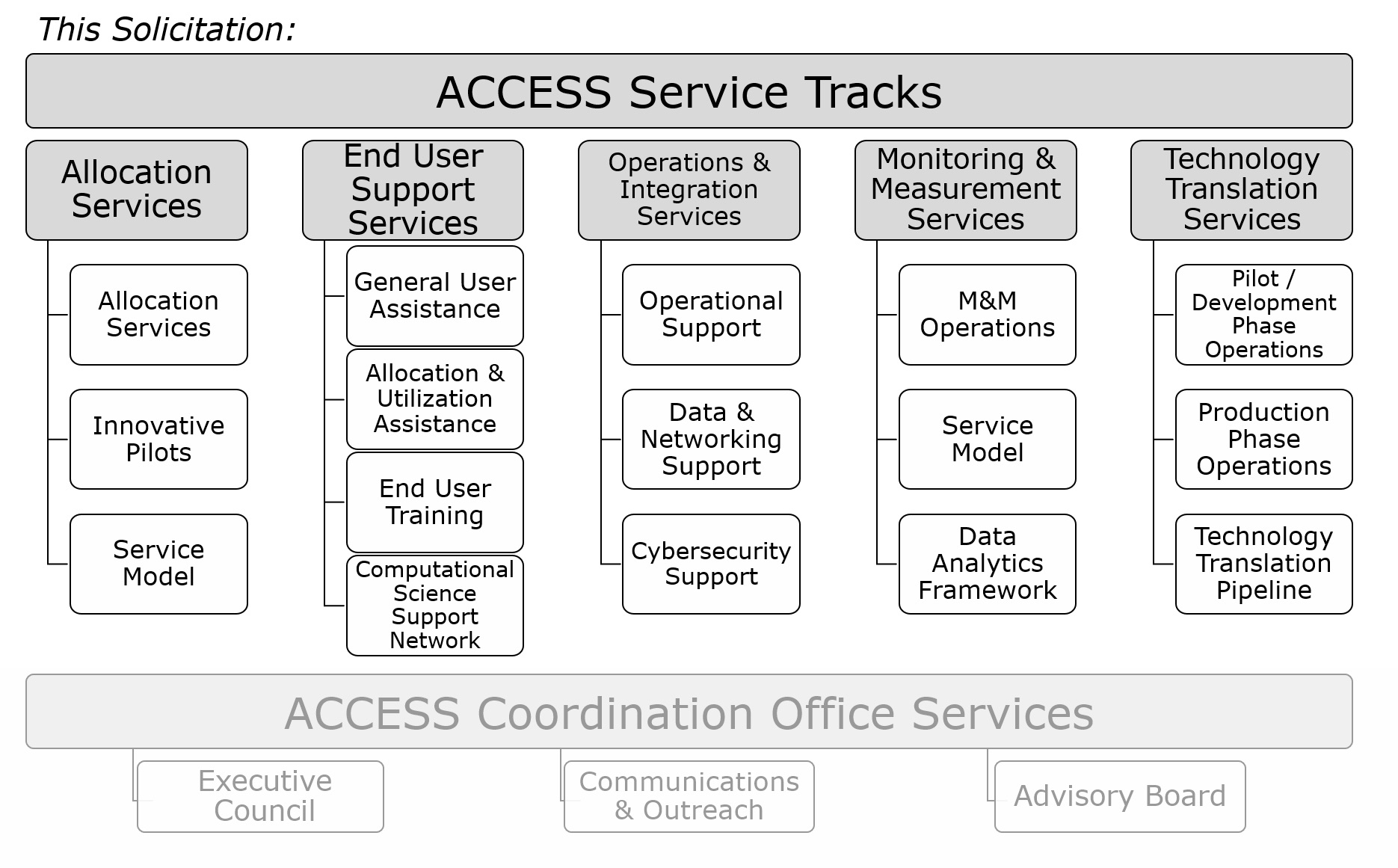
FIU and AmLight are participating in Track 3: Operational & Integration Services with sub-award “The COre National Ecosystem for CyberinfrasTructure (CONECT) Award” to provide operations, data and networking, and cybersecurity support.
CONECT will be led by NCSA in partnership with the Florida International University, Indiana University, PSC, the San Diego Supercomputer Center at UC San Diego and the University of Chicago.
ACCESS’s CONECT project is a $20 million, five-year award, that delivers innovative integrations across the NSF-funded cyberinfrastructure ecosystem in operations, data, networking, and cybersecurity. Research and education in science and engineering are increasingly reliant on a seamlessly integrated, secure and robust ecosystem of advanced computing, data technologies, and human expertise. CONECT will employ agile mechanisms to integrate rapidly diversifying non-traditional resources by building on the successes of its predecessors to create a more dynamic, inclusive, reliable and secure ecosystem.
For more information click here
|


|
Americas-Africa Lightpaths Express and Protect (AmLight-ExP) project
Big data science in South America and Sub-Saharan Africa will dramatically evolve over the next five years, with increasing dependency on advanced cyberinfrastructure and programmable networking. Significant projects include The Vera Rubin Observatory, the High Luminosity Large Hadron Collider experiments and the Square Kilometer Array in S. Africa. AmLight-ExP supports high-performance network connectivity required by international science and engineering research and education collaborations involving the NSF research community, with expansion to South America and West Africa.
AmLight-ExP is a reliable, leading-edge infrastructure for research and education. With significant investments from the Academic Network of São Paulo, Brazil’s Research and Education network, the Association of Universities for Research in Astronomy, the regional network of Latin America (RedCLARA), and national R&E network of S. Africa (TENET/SANReN), the total bandwidth provided by AmLight ExP between the U.S. South America, and Africa is expected to grow to over 4 Tbps in aggregate capacity from 2020-2025. This flexible inter-regional infrastructure enables science communities to expand research and learning activities, empowered through access to scalable optical spectrum on submarine cables and programmable networks.
AmLight-ExP increases the rate of discovery. Faster discovery means quicker focus on the greatest benefit for society. AmLight-ExP is a catalyst for new communities of researchers and learners with a bridge, linking U.S. Hispanic and African students, teachers and researchers. AmLight-ExP is committed to serving the needs of graduate and undergraduate education through models that bring together students and the networking community with scientists from all domains.
View Full Press Release
View Website
|


|
2020 AtlanticWave-SDX
Open Exchange Points (OXPs) serve as meet points for connecting and facilitating the exchange of data between Research and Education (R&E) networks. They are critical cyberinfrastructure in the transit of data over long geographical distances, switching data flows from one R&E network to the next, to its destination. For example, data from the Vera Rubin Observatory will transit 6 OXPs as it moves from the southern to northern hemispheres. Operationalizing the transit of data flows across OXPs is increasingly important to minimize the impact from events on network services (hardware failures and soft failures). End-to-end network paths for these data flows are not under the control of any individual organization. Multiple R&E network operators must coordinate to establish geographically distributed end-to-end paths ? an effort that can take days to weeks.
Florida International University (FIU), University of Southern California Information Sciences Institute (USC-ISI) and University of North Carolina at Chapel Hill - RENCI are furthering AtlanticWave-SDX: a distributed experimental SDX, supporting research, experimental deployments, prototyping and interoperability testing, on national and international scales. AtlanticWave-SDX leverages innovations from the initial AtlanticWave-SDX project, introducing new capabilities, enabling OXPs to react to unplanned network events by adding intelligent closed-loop control of network services powered by in-band network telemetry.
AWAVE-SDX is comprised of two components: An infrastructure development component with optical super channels to reframe and reprovision network capacity between R&E backbone networks; An innovation component to build a distributed intercontinental experimental SDX by leveraging OXPs in the U.S., Chile, Brazil, and S. Africa.
View Press Release
View Website
|
|
Q-Factor
Energy Science Network (ESnet) and Florida International University (FIU) received a two-year National Science Foundation (NSF) Office of Advanced Cyberinfrastructure research grant for “Q-Factor: A framework to enable high-speed data transfer optimization based on real-time network state information provided by programmable data planes.” (NSF Award Abstract #2018754).
Communication networks are critical components of today’s scientific workflows. Researchers require long-distance, ultra high-speed networks to transfer huge data from acquisition sites (such as Vera C. Rubin Observatory, also knowns as Large Synoptic Survey Telescope in Chile) to processing sites, and to share measurements with scientists worldwide. However, while network bandwidth is continuously increasing, the majority of data transfers are unable to efficiently utilize the added capacity due to inherent limitations of parameter settings of the network transport protocols and the lack of network state information at the end hosts. To address these challenges, Q-Factor plans to use temporal network state data to dynamically configure current transport protocol parameters to reach higher network utilization and, as a result, to improve scientific workflows.
Q-Factor leverages programmable network devices with the In-band Network Telemetry (INT) application and delivers a software solution to process in-band measurements at the end hosts. Using Q-Factor on Data Transfer Nodes (DTN)s, TCP/IP parameters will be configured according to temporal network characteristics, such as round-trip time, network utilization, and network congestion. This tuning is expected to result in increased network utilization, shorter flow completion times, and significantly fewer packet drops caused by network buffers overflow. Additionally, Q-Factor is geared to save host memory by tailoring kernel parameters and buffers to optimal sizes.
Q-Factor targets a timely issue in communication networks: underutilization of ultra high-speed networks for science workflows. In order to keep scientific progress unconstrained, future science workflows need to support emerging data-intensive science experiments (e.g., the Vera Rubin Observatory, High Luminosity Large Hadron Collider) where data generation grows significantly, reaching exabytes of traffic each year. Results of this project will also allow better understanding of optimal buffer sizes of network devices for huge flows and the interaction of various congestion control algorithms.
Experimental measurement data, network state information, network topology, software code, TCP tuning guidelines, and results will be available on the Q-Factor website https://q-factor.io, which will be maintained and indexed for at least three years after the completion of the project.
View Press Release
View Website
|

|
AmLight-SACS: South Atlantic Cable System (SACS)
Linking South and North America via a South Atlantic high-performance Research & Education Network (REN) with the nations of Africa’s researchers, students, knowledge creation and knowledge sharing communities has become an increasingly strategic priority. Africa offers research and education communities with unique biological, environmental, geological, anthropological, and cultural resources. Research challenges in atmospheric and geosciences, materials sciences, tropical diseases, biology, astronomy, and other disciplines will benefit by enhancing the technological and social connections between the research and education communities of the US, Brazil, and Africa. For many years, we have seen the dramatic benefits of high-performance networking in all areas of science and engineering. This supplemental funding request to the US National Science Foundation under the AmLight-ExP project would provide a bridge from the current infrastructure, to one that will provide unprecedented resources for research and education communities.
The goal of this request for supplementary funds is to enhance research and education collaborations between the U.S. and the nations of Africa by using the new SACS subsea cable system in the South Atlantic. The funds we are requesting are to purchase and install the necessary NEC Transponders to activate the spectrum on SACS. The equipment procurement and installation will be done by Angola Cables and is inclusive of operations and maintenance O&M.
Activating the spectrum on SACS, and then interconnecting SACS to both the WACS and Monet cables will allow an express connection between Africa and the USA. Moreover, the global R&E fabric can be strengthened from the additional pathways through the southern hemisphere.
View Website
|
|
AmLight-INT: In-band Network Telemetry
To enhance the SDN network telemetry capability of the AmLight Express and Protect (AmLight-ExP) project with in-band Operation/Administration/Management (OAM) to support multiple 100G real-time big-data transfers with complex SLA requirements between the U.S. and South America
With current technology, based on legacy systems and monitoring protocols, it is very complex and time-consuming to troubleshoot network transient events. These short-term and sporadic degradations in network performance often go undetected and have a high impact (packet loss) over big-data transfers in networks with a high delay-bandwidth product, such as AmLight-ExP’s international links. AmLight-INT proposes to respond to these challenges by changing the forwarding pipeline to include telemetry functions directly on the data plane. Generating and exporting telemetry metadata directly on the data plane can be performed at line-rate without affecting at all the control plane functions. Gathering telemetry metadata directly from the data plane will allow the AmLight-ExP SDN network to receive and process telemetry information in real-time with the capacity of feeding the AmLight-ExP SDN controller and user applications with the network status for fast reaction. Applications, such as Large Survey Synoptic Telescope, would benefit from sub-second network status to compensate interface queue utilization, packet drops, and link utilization. With real-time network utilization, the AmLight-ExP SDN controller will be able to optimize interface buffer sizes to accommodate multiple high-priority flows in parallel, avoiding tail drops that ultimately lead to poor data transfer performance.
AmLight-INT will be a coordinated project, using NSF investment, with industrial partners to develop a hardware-software solution capable of performing in-band network telemetry using the P4 language. NSF support will be used to acquire P4-capable switches, connectivity components, and staff support for research and software development during the twenty-four-month project.
By determining how to deploy and use in-band network telemetry, AmLight-INT will bring a new resource to science and education and will transfer the understanding of this new technology to the R&E network community. As vendors and network operators do not deploy data plane-based in-band network telemetry, this project will be an opportunity for U.S. Computer Science and Engineering graduate students to be in on the ground floor of international technology innovation. The result will be enabling network monitoring and troubleshooting to an unprecedented level. We expect that at the end of this project, a new network design paradigm will have been created, presented, and used by network operators. The results will further benefit the future needs for high-speed international connectivity by creating an approach that efficiently mitigates transient network issues. Moreover, it will underscore that research partnership are possible between switch manufacturers, operators, and the research community. As the AmLight-INT will be exclusively based on standard protocols/open source solutions, other network manufacturers will profoundly benefit from such project, enhancing the whole networking ecosystem.
View Press Release
View Website
|

|
Americas Africa Research and eduCation Lightpaths (AARCLight)
Florida International University and AmLight consortium partners are planning, designing, and defining a strategy for high capacity connectivity research and education network connectivity between the US and West Africa, called AARCLight: Americas Africa Research and eduCation Lightpaths (NSF Award# 1638990). Science is being conducted in an era of information abundance. Sharing science resources, such as data, instrumentation, technology, and best practices, across national borders, can promote expanded scientific inquiry and has the potential to advance discovery. Linking the U.S. and the nations of Africa’s researcher and education communities is an increasingly strategic priority. Africa offers research and education communities with unique biological, environmental, geological, anthropological, and cultural resources. Research challenges in atmospheric and geosciences, materials sciences, tropical diseases, biology, astronomy, and other disciplines will benefit by enhancing the technological and social connections between the research and education communities of the US and Africa.
The planning project is largely based on the planned availability of submarine cable spectrum for use by research and education communities. It creates an unprecedented opportunity for the stakeholders in the U.S., Africa, and Brazil to coordinate planning efforts to strategically make use of the offered spectrum towards serving the broadest communities of interest in research and education. The AmLight consortium partners are the (Brazilian Education and Research Network (RNP), Academic Network of São Paulo (ANSP), Latin American Cooperation of Advanced Networks (CLARA), Chile’s Red Universitaria Nacional (REUNA), Florida LambdaRail (FLR), Association of Universities for Research in Astronomy (AURA), and Latin American Nautilus.
View Website
|
|
Americas Lightpaths Express and Protect (AmLight ExP)
Science research and education activities between the U.S. and nations in South America have been evolving, benefiting from the shared investments between the U.S., Brazil and other nations in Latin America. Astronomy, High-Energy Physics, Comparative research in Biodiversity, Ecology and Genomics, Materials Science, Seismology, Future Internet Research, Ultra-High Definition (UHD) video and streaming research collectively represent a suite of collaborative science research communities, with resources and cyberinfrastructure geographically dispersed across the U.S. and the nations of Latin America with diverse network services requirements. As data production of science applications increases, so to is the demand for high-throughput production network services to transport data from where it is collected, processed, then archived.
In response to the network requirements of these U.S.-Latin America collaborative science research communities, the AmLight Express and Protect (ExP) implements a hybrid network strategy that combines optical spectrum (Express) and leased capacity (Protect) that builds a reliable, leading-edge diverse network infrastructure for research and education. Researchers will be able to leverage the resources of AmLight ExP to foster network innovation and to address increasing network services requirements between the U.S. and the nations in South America.
AmLight ExP is a reliable, leading-edge infrastructure for research and education. With significant investments from the Academic Network of São Paulo (ANSP), and Rede Nacional de Ensino e Pesquisa (RNP) and the Association of Universities for Research in Astronomy (AURA), the total bandwidth provided by AmLight ExP between the U.S. and South America is expected to grow to more than 680 Gibabits per second in aggregate capacity between 2015 and 2020. This serves as a flexible inter-regional infrastructure, enabling communities of scientists to expand their research, education, and learning activities uniquely empowered through access to unlit optical spectrum on submarine cables, and through AmLight ExP's use of dynamic circuits in a production environment. AmLight ExP increases the rate of discovery in the U.S. and across the Western Hemisphere. Faster discovery means quicker focus on the greatest benefit for society. AmLight ExP acts as a catalyst for new communities of researchers and learners with a bridge linking Latin Americans of the Western Hemisphere, benefiting U.S Hispanic students, teachers and researchers. FIU is committed to serving the needs graduate and undergraduate education through models that bring together students and the networking community with scientists from all domains.
View Press Release
View Website
|
|
AtlanticWave-SDX
Demand is growing to develop the capability to support end-to-end services, capable of spanning multiple Software Defined Networking (SDN) domains. SDN deployments that cross multiple domains continue to be constructed manually, involving significant coordination and effort by network operators. Moreover, the demand for more intelligent network services to support the evolving science research and education activities between the U.S. and South America are increasing; these network services, which include dynamic provisioning of end-to-end multi-domain layer2 circuits, and network programmability, are needed to foster innovation for application developers, and to increase efficiency for network operators. AtlanticWave-SDX is a response to the demand for more intelligent network services to foster innovation and to increase network efficiency.
Florida International University (FIU) and the Georgia Institute of Technology (GT) are implementing AtlanticWave-SDX: a distributed experimental Software-Defined Exchange (SDX), supporting research, experimental deployments, prototyping and interoperability testing, on national and international scales. A Software-Defined Exchange (SDX) will provide a capability to prototype an OpenFlow network where members of each Internet peering fabric could exchange traffic based in different layers of abstraction.
AtlanticWave-SDX is comprised of two components: (1) a network infrastructure development component to bridge 100G of network capacity between Research and Education (R&E) backbone networks in the U.S. and South America; and (2) an innovation component to build a distributed intercontinental experimental SDX between the U.S. and South America, by leveraging open exchange point resources at SoX (Atlanta), AMPATH (Miami), and Southern Light (São Paulo, Brazil).
View Press Release
View Website
|
|
Vera Rubin Observatory (p.k.a. Large Synoptic Survey Telescope - LSST)
Florida International University’s Center for Internet Augmented Research and
Assessment (CIARA) is pleased to announce AMLIGHT’s long-term support for a high-speed network, linking the NSFfunded Large Synoptic Survey Telescope (LSST) to the National Center for SuperComputing Applications (NCSA) and
beyond through a sub-award from the Association of Universities for Research in Astronomy (AURA). This unprecedented
long-term infrastructure will provide committed bandwidth capacity for LSST’s explicit needs, and communal bursts within the
AMLIGHT collaboration. The network architecture is a critical component of the design of LSST. AMLIGHT has contributed to the design of the network architecture for LSST, and supported the evolution of the regional network infrastructure since site planning in 2006.
The network architecture allows for a design of LSST utilizing the computational resources of NCSA in Illinois to process in
near real time the data from the telescope in Northern Chile.
The AMLIGHT collaboration will deploy multiple 100G links from Miami, to Fortaleza, Brazil, to São Paulo, and to Santiago, Chile, to provide the underlying infrastructure to support LSST’s committed bandwidth, and burst needs. Partners in the U.S. that interconnect with AMLIGHT and will help transport LSST’s data to NCSA include Florida LambdaRail, Internet2, and ESnet.
This commitment to international network-enabled major research instruments creates an exciting new frontier for U.S. and
collaborative science. The LSST will be able to look throughout the Universe, and within seconds, relying on AMLIGHT,
deliver images of distant stars and galaxies to NCSA, where they are processed and made ready for science.
LSST's construction funding will be provided through NSF's Major Research Equipment and Facilities (MREFC) account. LSST passed its NSF Final Design Review in December of 2013; the National Science Board gave the NSF conditional
approval to move the project to construction status in May of 2014. NSF issued a new CSA for LSST Construction to AURA
in August of 2014 initiating the formal NSF LSST Construction Project. On the DOE side, LSST received Critical Decision-1
approval (CD-1) in 2011 and also just received CD-3a approval, which allows the project to move forward with the sensor
long-lead procurements. The CD-2 review will take place the first week in November, with approval expected shortly
afterward, formally fixing the baseline budget for completion of the camera project. The Particle Physics Project Prioritization
Panel (P5), an advisory subpanel of the High Energy Physics Advisory Panel (HEPAP), recommended in May of 2014 that
DOE move forward with LSST under all budget scenarios, even the most pessimistic.
View Press Release
View Website
|

|
SwitchOn
Florida International University (FIU) proposes the SwitchOn project, which aims at exploring existing and future collaborative opportunities in Future Internet research between the US and Brazil. FIU will lead a coordinated effort for supporting, strengthening, and expanding research collaborations between the two countries. The project will achieve three specific objectives, including: creating a mechanism to stimulate participation of US and Brazilian researchers in Future Internet research, providing coordination for high-impact research collaborative activities between the US and Brazil, and exploring and identifying common interests in research and development to prepare for future large-scale collaborative research activities in Future Internet between the two countries.
View Website
|
 |
OpenWave-AmLight
OpenWave, a project under the NSF IRNC AmLight ProNet Award, is deploying an unprecedented experimental 100G of interconnectivity between the U.S, and Brazil. The OpenWave experiment's intellectual merit is a breakthough undertaking of a single 5600 km submarine link using a 100G wave. AmLight OpenWave utilizes optical hardware that has never before been commercially deployed underwater at this distance. The 100G will be first on a wave between St. Croix, USVI, and Fortaleza, Brazil, then Miami to St. Croix and Fortaleza to São Paulo. AmLight will experimentally deploy the OpenWave 100G of interconnectivity with industry partners and then develop the infrastructure to ensure the bandwidth is effectively integrated into the fabric of AmLight - enabling the frontier of science today.
Undersea telecommunications facilities connecting the U.S. to Brazil are constrained. To date, there are three oversubscribed undersea fiber optic cable systems in service between the U.S. and Brazil. All pairs are in use. All have extreme saturation near the blue end of the optical spectrum due to the legacy load of waves established over four years of growth. OpenWave's objective is to discover and implement how a 100G trans-oceanic wave can be deployed and tested on a highly constrained undersea fiber optic cable system without impacting production services.
Leveraging AmLight's long-standing research and education networking and industry partnerships, the OpenWave experiment sets out to test a 100G alien wave end-to-end from São Paulo to Miami. First, a 6-month trial is being conducted in the laboratory to determine through experimentation the feasibility of 100G transport between the U.S. and Brazil. Then, after the trial tests of the optical technology OpenWave will be deployed on industry partner Latin American Nautilus' available spectrum on a production transoceanic cable system via an alien wave.
OpenWave's broader impacts are to determine how to operate 100G at 5600 km effectively between North and South America to bring a new resource to science and education and transfer the understating of a new technology to the commercial space. AmLight's OpenWave provides a never before opportunity for U.S. computer science and engineering graduate students to be in on the ground floor of international technology innovation. The end result will be enabling a future of submarine connectivity towards available rate parity with terrestrial infrastructure. This network resource will foster a far reaching and trans-domain research and education enablement throughout the Western Hemisphere.
View Press Release
|
 |
Secure Access for Everyone (SAFE)
Multi-institutional distributed scientific research collaborations involving the sharing of resources are challenging and fraught with a lot of effort in obtaining and managing multiple identities. Secure Access for Everyone (SAFE) creates an Identity and Access Management (IAM) infrastructure that facilitates easy access to campus Cyberinfrastructure (CI) resources for local, state, regional and national researchers. SAFE will achieve this by implementing the following three-part strategy: (1) Integrating CI resources with opensource IAM software; (2) Facilitating collaboration and coordination of multi-institutional resources; and (3) Leveraging custom gateways using InCommon for federated access. The gateways to these resources are enhanced to include multiple access methods, including web and command line and integrate the use of HPC schedulers and access from the Open Science Grid. The SAFE architecture initially provides federated access to library databases, High Performance Computing resources, Virtual Computing Lab (a cloud based compute reservation environment), and the Sunshine State Educational and Research Computing Alliance?s (SSERCA) collaborative storage ecosystem. CI resources such as these perform a key role in supporting scientific collaborations across campuses, regional, national, international and virtual organizations, and spanning scientific communities. These multi-institutional science research collaborations involving the sharing of resources are challenging and fraught with a lot of effort in obtaining and managing multiple identities. SAFE solves this by allowing researchers to login to CI resources with their local institutions credentials for trusted access.
Secure Access for Everyone (SAFE) is a well coordinated usable federated identity and access management system that leverages and enhances campus CI in order to support trusted collaboration and sharing of compute and data resources that is now essential to facilitate multi-institutional scientific research collaborations.
View Award Abstract
|
 |
FlowSurge
FlowSurge proposes to build a science network and a Science DMZ at FIU that can be tailored to support the needs of high- performance science applications and data-intensive flows. Researchers, from their laboratory, will be able to generate science flows to shared CI or CI- connected resources on the campus; at other campuses; or at regional, national or international sites. "FlowSurge Rack" optimized for high-performance and programmability of science applications, and instrumented for monitoring and measuring science flows, will be installed in the laboratories of researchers and connected to the FlowSurge Science Network and Science DMZ. FlowSurge leverages CI resources for Software Defined Networking (SDN) on the FIU campus network, at the AMPATH International Exchange Point, and at national and international networks at AMPATH to support end-to-end science flows.
The initial suite of science applications suggested for this proposal are in the physical and computational sciences with applications in the domains of high-energy physics, optical astronomy, climate modeling, real-time large-scale network simulation, and cloud computing.
View Wiki
View Press Release
|
|
AmLight (Americas Lightpaths)
Unparalleled Access across the Western Hemisphere AMLIGHT interconnects research and education networks from across the hemisphere, including those of CLARA (Cooperation of Latin American Research networks encompassing Latin American countries), RNP (the Brazilian NREN),
ANSP (the State of Sao Paulo network) and ESnet, Florida LambdaRail, Internet2, National LambdaRail, and regional networks serving the United States.
Today's applications depend on low latency and jitter. AMLIGHT's direct, global peerings mean that video conferencing works, that 4K video is a reality, and that experiments are iterated and understood in near real time. AMLIGHT delivers interconnectivity that uniquely supports these dynamic interconnections. AtlanticWave AMLIGHT connects to AMPATH in Miami, and, because of AtlanticWave, AMLIGHT is also in New York City, Washington D.C., Atlanta, and Sao Paulo.
AtlanticWave is a unique infrastructure that AMLIGHT leverages to provide a single peering fabric from New York to Sao Paulo—those connected to it have the same interconnectivity benefits as those in New York City. Meaning, a concert hall in Manhattan can be connected to a concert hall in Miami as easily and as quickly as if they were next-door neighbors. Leadership and Support for Research AMLIGHT responds to partner needs and enables an evolving terrain of research and education infrastructure. This robust system includes:
• Advanced technical infrastructure
• Responsive maintenance
• Hurricane-proof facilities
Engagement in Evolving Network Technology AMLIGHT plays a role in the next generation of network and collaborative research so it is poised to support its connectors when they need it. To ensure these future needs are met, we must work on them today. To that end, AMLIGHT has obtained more than $20 million to participate in federally funded research—the benefit of which will manifest directly to connectors, who will have access to tomorrow's new technologies, such as dynamic networking and the streaming of uncompressed 4K video.
View Brochure
View Website
|
 |
Open Science Data Cloud (OSDC)
Miami, FL. – The NSF has awarded a 5-year grant to the OCC Open Science Data Cloud project. Florida International University has been selected as a participant and will be sending students to Universities from ourInternational Partners this summer to conduct research for the OSDC-PIRE program.
The international PIRE project aims to narrow the growing gap between the capability of modern scientific instruments to produce data and the ability of researchers to manage, analyze, and share those data in a reliable and timely manner.
The emerging technology of cloud computing is a step forward from the current cyberinfrastructure. Cloud computing involves clusters ,the "clouds", of distributed computers that provide potentially less expensive, more flexible, and more powerful on-demand resources and services over a network, usually the Internet, while providing the scale and the reliability of a data center.
Scientists at the University of Chicago, the University of Illinois at Chicago, and Florida International University will collaborate with six international research groups located in Europe (Amsterdam and Edinburgh), Asia (Seoul and Beijing), and South America (Rio de Janeiro and Sao Paulo). The team includes experts in cloud computing, high-performance networking, e-Science, education and outreach.
Renowned astronomer, Dr. Alex Szalay of Johns Hopkins University, is working with the OSDC for developing cloud computing infrastructure for managing and analyzing the Sloan Digital Sky Survey astronomical dataset. Dr. Kevin White from the University of Chicago is partnering for developing cloud computing infrastructure for analyzing biological data.
This PIRE team intends to help develop a large-scale system of distributed computing capabilities – the Open Science Data Cloud (OSDC) – to provide long term persistent storage for scientific data and state-of-the-art services for integrating, analyzing, sharing and archiving scientific data. In addition to the research dimensions of this project, OSDC-PIRE will conduct workshops in the use of the cloud cyberinfrastructure aimed at many domain scientists and their students. Graduate students and early career scientists can apply to work with our OSDC foreign partners.
"The Open Science Data Cloud will contain over 1 petabyte (1000 terabytes)* of persistent scientific data from a variety of fields. It will not only store the data but also allow scientists to compute over it
View Brochure
View Website
|
 |
GENI
FIU Computer Science and CIARA proposal receives funding from the National Science Foundation
FIU Computer Science's Jason Liu, and CIARA's Julio Ibarra and Heidi Alvarez submitted a winning proposal to the National Science Foundation (NSF) Global Environment for Network Innovations (GENI) program. The NSF GENI program is creating a virtual laboratory for computer scientists and network researchers to explore the design and behavior of future internets, which will lead to increasing understanding on how to innovate and transform global networks and their interactions with society.
The GENI grant to FIU's proposal recognizes the investigators strengths in network research and network operations. The funds are for the implementation of real-time network simulation capabilities into the GENI computational and network research environment to support large-scale experiments involving both physical and simulated network objects. The award extends the GENI infrastructure to partnership programs in Brazil including the Academic Network of Sao Paulo (ANSP) and the National Research and Education Network of Brazil (RNP).
The project will utilize key network infrastructure to create an environment in which real-time network simulation experiments can be conducted between FIU, computer and network researchers in the U.S. and Brazil including the AMPATH International Exchange Point, http://www.ampath.net/, a project of FIU, serving as the premiere interconnection point for network-enabled U.S.-Latin America and Caribbean science research and education; the international research network connections, managed at CIARA on behalf of the NSF, which connect the U.S. science and engineering research and education community to Latin America (hhttp://www.redclara.net/index.php/en/conocimiento-e-innovacion/articulacion/finalizados/whren-lila); and the Southern Light International Exchange Point in Sao Paulo co-managed by CIARA, ANSP, and RNP.
View Website
|
 |
AMPATH IXP
Housed at the NAP of the Americas, the mission of AMPATH is to serve as the pathway for Research and Education Networking in the Americas and to the World and to be the International Exchange Point for Latin America and the Caribbean R&E networks.
View Brochure
View Website
|
 |
ATLANTIC WAVE
AtlanticWave is an international peering fabric interconnecting: US, Canada, Europe, and South America. With distributed IP peering points in New York, Washington D.C., Atlanta, Miami, and Sao Paulo.
View Website
|
 |
CHEPREO
Florida International University (FIU), in collaboration with partners at Florida State University (FSU), the University of Florida (UF), and the California Institute of Technology (Caltech), operate an inter-regional Grid-enabled Center for High-Energy Physics Research and Educational Outreach (CHEPREO) at FIU, encompassing an integrated program of research, network infrastructure development, and education and outreach at one of the largest minority schools in the US.
View Website
|
 |
CISCO-URP
The Academic Research and Technology Initiatives (ARTI) team is focused on engaging the Research and Education community in creating innovation, research and development opportunities for advanced networking infrastructures in research and education networks and related projects around the world. We work with National Research Networks (NRN), Gigapops, government research networks, and higher education institutions to identify emerging technologies and solutions and to foster research and collaboration on networking technologies. We fund forward-looking research that may have long term systemic impact on networks and networking technologies.
View Website
|
 |
CMS-CERN
CERN is the European Organization for Nuclear Research, the world's largest particle physics laboratory, situated on the border between France and Switzerland, just west of Geneva. It is the world's largest research centre for particle physics and the birthplace of the World Wide Web. The convention establishing it was signed on September 29, 1954. From the original 12 signatories of the CERN convention, membership has grown to the present 20 Member States.
Its main function is to provide the particle accelerators needed for high energy physics research and numerous experiments have been constructed at CERN by international collaborations to make use of them. The main site at Meyrin also has a large computer centre containing very powerful data processing facilities primarily for experimental data analysis, and because of the need to make them available to researchers elsewhere, has historically been (and continues to be) a major wide area networking hub.
CERN currently employs just under 3000 people full-time. Some 6500 scientists and engineers (representing 500 universities and 80 nationalities), about half of the world's particle physics community, work on experiments conducted at CERN.
View Website
|
 |
CYBERBRIDGES
CyberBridges is a multidisciplinary pilot program that will fund 4 graduate student fellowship positions in Science or Computer Engineering, each receiving a stipend, tuition, and a CIARA IT Science Certificate from FIU. The goal of CyberBridges is to bridge the divide between the Information Technology communities and the science disciplines by presenting students with an avenue where they can explore applications of Cyber Infrastructure research within their domains. CI-TEAM proposal will be funded by the National Science Foundation from October 1, 2005 thru September 30, 2006.
View Website
|
 |
GLOBAL CYBERBRIDGES
The CIARA model will likely have a much larger impact: a Global CyberBridges project (GCB) funded by the NSF for three years, from October 2006 - 2009. The adoption and use of cyberinfrastructure is further complicated by the fact that collaborations between globally distributed researchers are subject to a variety of global “Gaps” between the work-sites. Even with all our emerging information and communication technologies, distance and its associated attributes of culture, time zones, geography, language, and social protocol affect how humans interact with each other. Seldom are these failures of technology or lack of economic resources. Often they are social failures, born out of inappropriate workflow and protocol designs. Thus, consciously managing the consequences of these “Gaps” and the resulting “Polycontextuality” is essential to the success of global collaborations. Polycontextuality occurs in a distributed environment and can be described as the challenge experts face when they attempt to bridge multiple communities or contexts. Global CyberBridges will help in two ways – it will develop a body of experience, guidelines, and theory that will be useful in designing global research communities in the future. Second, it will also help build such collaboration between scientists from the US, China, and Brazil, nations with very different cultures, traditions, and infrastructures. Furthermore, we will be developing a community – as a proof of concept – and while building this community we will also create a body of knowledge that will be useful for building future e-Science communities.
View Website
|
 |
SCIENCE GRID
The Open Science Grid is a distributed computing infrastructure for large-scale scientific research, built and operated by a consortium of universities, national laboratories, scientific collaborations and software developers.
View Website
|
 |
US-CMS
Collaboration of US scientists participating in the Compact Muon Solenoid (CMS) experiment at the Large Hadron Collider (LHC) at CERN in Geneva, Switzerland.
View Website
|
 |
ULTRALIGHT
UltraLight is a collaboration of experimental physicists and network engineers whose purpose is to provide the network advances required to enable petabyte-scale analysis of globally distributed data. Current Grid-based infrastructures provide massive computing and storage resources, but are currently limited by their treatment of the network as an external, passive, and largely unmanaged resource.
View Website
|
  |
WHREN LILA
Western-Hemisphere Research and Education Networks - Links Interconnecting Latin America (WHREN-LILA) is a project made possible from funding provided by the National Science Foundation (NSF) Award #0441095 and the State of Sao Paulo Research and Science Foundation (FAPESP) Award #2003/13708-0.
It is also made possible from the participation of the following projects and organizations: Florida International University, AMPATH, CENIC, the Academic Network of Sao Paulo (ANSP), the Cooperation of Latin American National Research Networks (CLARA), the National
Research Network of Brazil (RNP) and the National Research Network of Mexico (CUDI).
View Brochure
View Website
|
|
|
|
|
|